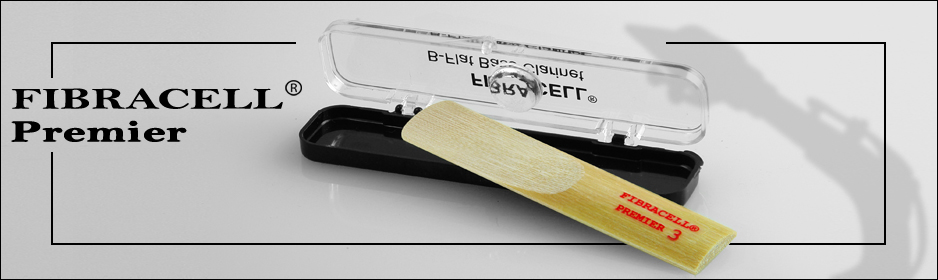
| Features of
Fibracell Reeds:
Why does Fibracell
sound so good? Because it's not plastic and it's not cane. It's the most highly
developed composite structure ever engineered for woodwinds!
With Fibracell You Get:
- The same "woody" tone
as cane but with better sound projection.
- A reed that is great
for doublers because it does not require soaking.
- A reed that is
playable in all weather conditions, not affected by heat or
humidity.
- A reed that does not
swell, warp or soften when wet.
- A reed that lasts up
to six times longer than cane with no unplayable reeds, making it less
expensive to use than cane.
- Quick response for
better articulation, excellent pitch stability and intonation in all ranges,
even for the clarinet.
- Brilliant overtones
for a full, vibrant, resonant tone.
- A reed with the same
weight and stiffness as cane - cane floats and so does Fibracell (try that with
a plastic reed!)
- A reed that keeps its
shape and retains resiliency longer than cane.
- Outstanding
durability, due to a bonded film on the bottom that helps resist tip
splitting.
- A product that is made
in the USA, by a former music educator.
What You Don't Get Is:
cane's inconsistent quality and short life.
Description of Fibracell:
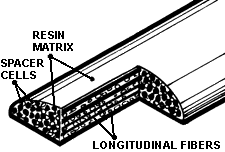
Fibracell studied natural cane reed material under a microscope and
used the most advanced fibers and composites from the aerospace industry to
exactly duplicate the properties of natural cane reed material. Very stiff but
sound absorbing Kevlar fibers are suspended in a lightweight resin formulation.
It took the inventor, David W. Shaffer, over a decade of research to get the
numbers of fibers, spacing, density of matrix, position of voids and other
variables just right, but it was worth it.
Fibracell is manufactured
to exacting production standards and is precisely machined and trimmed for a
consistently perfect shape.
Experts in the fields of both music and
manufacturing Fibracell have spent many years perfecting the formulas and
processes used to make Fibracell reed material and to shape it into reeds that
play the way musicians have always wanted but only rarely found in natural
cane.
In short, Fibracell is the epitome of consistency and quality. To
the musician, that means a reed that won't let you down. |
|
Technical Aspects of
Fibracell |
What Is
Fibracell?
Fibracell material is
a sophisticated composite of aerospace materials designed to exactly duplicate
the way nature constructs cane reed. Very stiff but sound absorbing Kevlar
fibers are suspended in a lightweight resin formulation.
Fibracell
composite reed material is the result of years of research and development,
conceptualizing and augmenting state-of-the-art materials. The result is a
composite material, which has characteristics comparable to natural cane reed
in the following respects: |
- Stiffness
- Specific Gravity
- Decay Factor
- Overtones or
"Voice"
- Stiffness-to-weight ratio
- Color and
appearance
|
|
|
|
| It is the unique combination of the above properties that allows the
natural cane reed to vibrate with a rich tonal quality. These qualities are
emulated in Fibracell's unique composite structure with the additional features
of strength, long lasting durability and a consistency of quality not found in
nature. |
Visual
Features:
The visual similarity
of Fibracell to cane, even with a microscope, is remarkable because it's color
and cross-section structure are almost identical in appearance to cane. Thus,
the claim can accurately be made "It plays like cane because it's made like
cane. Only stronger!" Fibracell reeds can quickly be distinguished from all
other artificial reeds by a "float test". Drop a handful of plastic, cane and
Fibracell reeds in a glass of water. Only the cane and Fibracell reeds will
float. The plastic reeds will sink to the bottom. This demonstrates the
similarity in density and specific gravity between natural cane and Fibracell
material as opposed to the more dense plastic. The lightness of cane and
Fibracell is important for high note stability and the formation of correct
overtones.
Production:
Fibracell is manufactured in a process that
includes over ten production, machining and quality control operations, as
opposed to simple injection molding like most plastic reeds. The materials used
to produce the raw material are sophisticated and relatively expensive. The
equipment used to produce it is extremely sensitive and complicated. Many
factors contribute to its quality.
Once the material is produced,
making reeds from it is done in almost exactly the same way cane reeds are
produced with all the same cutting, milling, shaping, trimming and testing
steps. In other words, the Fibracell reed is the result of a combination of
expensive, sophisticated materials, many years of research and a labor
intensive manufacturing and quality control process. |
|